

In short: AI is governed through four kinds of instrument: comprehensive binding laws (the EU, South Korea), promotion-first laws and voluntary guidance (Japan, the United Kingdom, Singapore, and the US federal posture), targeted rules (China’s labeling measures, US state laws) and international instruments (the Council of Europe treaty, summit declarations such as New Delhi’s). Underneath, nearly all ask for the same five things, which is why one well-built program can serve many jurisdictions.1,2,3,4,5,6,7
India hosted the AI Impact Summit in New Delhi in February 2026. Its New Delhi Declaration, centered on inclusive benefit from AI rather than on binding rules, was endorsed by 88 countries and international organizations at the close of the summit; later in February India’s Ministry of Electronics and Information Technology reported that three more countries had joined, taking the total to 91.1,8 Declarations do not create obligations for companies, but they show where governments are trying to agree. This is a good moment to step back and map the approaches that do create obligations.
Four models of AI governance
| Model | Examples | Binding on companies? | Date to watch |
|---|---|---|---|
| Comprehensive, binding law | EU AI Act; South Korea’s AI Basic Act (in force January 22, 2026) | Yes | EU high-risk rules: August 2026 under the Act, December 2027 under the Commission’s proposed delay2,9 |
| Promotion-first law or voluntary guidance | Japan’s AI Promotion Act; UK AI Opportunities Action Plan; Singapore’s model frameworks; US Executive Order 14365 | Mostly no; existing law still applies | Japan’s Basic AI Plan; the US federal framework recommendations ordered by EO 143653,4,5,10 |
| Targeted rules | China’s AI content labeling measures; US state laws on hiring, deepfakes, frontier models | Yes, for the covered use | Each rule’s own effective date6 |
| International instruments | Council of Europe Framework Convention; summit declarations | Treaty binds states that ratify it; declarations bind no one | Ratifications by the states where you operate7 |
- Comprehensive, binding law. The European Union’s AI Act is the reference case; in November 2025 the Commission proposed moving its stricter high-risk obligations from August 2026 to December 2027 as part of a “Digital Omnibus” package, which the Parliament and Council still have to agree.9 South Korea’s AI Basic Act joined it on January 22, 2026, with duties for “high-impact” AI and a domestic-representative requirement for foreign operators.2
- Promotion-first framework laws and guidance. Japan’s AI Promotion Act, passed on May 28, 2025, sets up an AI Strategy Headquarters and a Basic AI Plan without penalties.3 The United Kingdom has no AI statute; its AI Opportunities Action Plan of January 13, 2025 made 50 recommendations on compute, data and adoption, and existing regulators apply existing law.4 Singapore publishes voluntary model frameworks, most recently one for agentic AI launched on January 22, 2026.5 In the United States, Executive Order 14365 of December 11, 2025 set out to build a national policy framework and to challenge state AI laws the administration considers burdensome; it does not itself regulate companies.10
- Targeted rules. China regulates through specific measures; its rules on labeling AI-generated content took effect on September 1, 2025, with a mandatory national standard for visible and embedded labels.6
- International instruments. The Council of Europe’s Framework Convention on AI, the first legally binding international AI treaty, opened for signature on September 5, 2024, with the EU, the United Kingdom and the United States among the first signatories.7
Our earlier briefings cover several of these in depth: Korea’s Act, Singapore’s agentic framework, what EO 14365 does and does not do, and the EU rules for general-purpose models.
The convergence underneath
For a manager, the differences matter less than what the models share. Almost every one asks for the same things in different words: notice to the people affected, an assessment of impact before consequential use, documentation, human oversight of decisions that matter, and a way to report and fix incidents. A program built to that common standard turns each new jurisdiction into a mapping exercise rather than a new project. Frameworks such as the NIST AI RMF and ISO/IEC 42001 are built around exactly those elements, which is why they travel well.
A practical habit
Keep a one-page jurisdiction register for your AI systems: where the affected people are, which instrument applies there (binding law, guidance or none), the obligation that matters most, and the next date to watch. Review it each quarter, and add a line whenever a product launches in a new market. The register is one of the working documents built in Module 12 of the AIMP program.
Most of the work in global AI compliance is noticing change early enough to plan for it. The New Delhi Declaration changes no one’s obligations this year; the register is how you will notice the instruments that do.
Sources
- All India Radio News, "India AI Impact Summit 2026 adopts New Delhi Declaration" (February 2026) (opens in a new tab) newsonair.gov.in
- Cooley, "South Korea's AI Basic Act: Overview and Key Takeaways" (January 27, 2026) (opens in a new tab) cooley.com
- White & Case, "Japan's first AI legislation becomes law" (2025) (opens in a new tab) whitecase.com
- Mishcon de Reya, "UK Government launches AI Opportunities Action Plan" (January 2025) (opens in a new tab) mishcon.com
- CMS, "Singapore issues global-first agentic AI model governance framework at Davos" (January 29, 2026) (opens in a new tab) cms.law
- Loeb & Loeb, "China's AI Labeling Measures and Mandatory National Standards Take Effect September 1" (March 2025) (opens in a new tab) loeb.com
- Council of Europe, "Council of Europe opens first ever global treaty on AI for signature" (September 5, 2024) (opens in a new tab) coe.int
- Ministry of Electronics and Information Technology (Government of India), Digital India press release, "More countries join the New Delhi Declaration on AI Impact" (February 2026) (opens in a new tab) digitalindia.gov.in
- Euronews, "European Commission delays full implementation of AI Act to 2027" (November 19, 2025) (opens in a new tab) euronews.com
- Federal Register, Executive Order 14365, "Ensuring a National Policy Framework for Artificial Intelligence" (December 11, 2025), 90 FR 58499 (opens in a new tab) govinfo.gov
IAIM articles are educational and are not legal advice.
The full picture: this briefing is part of AI governance for managers.
Newsletter
Get the IAIM Briefing
A monthly summary of what changed in AI regulation, governance and practice, with the sources for every item. Free. Unsubscribe in one click. See a sample issue.
Related briefings
AI governance framework template: the sections, owners and review cycle that make one usable
Most governance templates list principles. A usable one gives every section a named owner and sets a review cycle around dates that are already fixed.
6 min read
ISO/IEC 42006 and how to choose who certifies your AI management system
A certificate is only as good as the body that issued it. Since 2025 there is a standard for the certifiers of ISO/IEC 42001, and buyers can ask about it.
4 min read
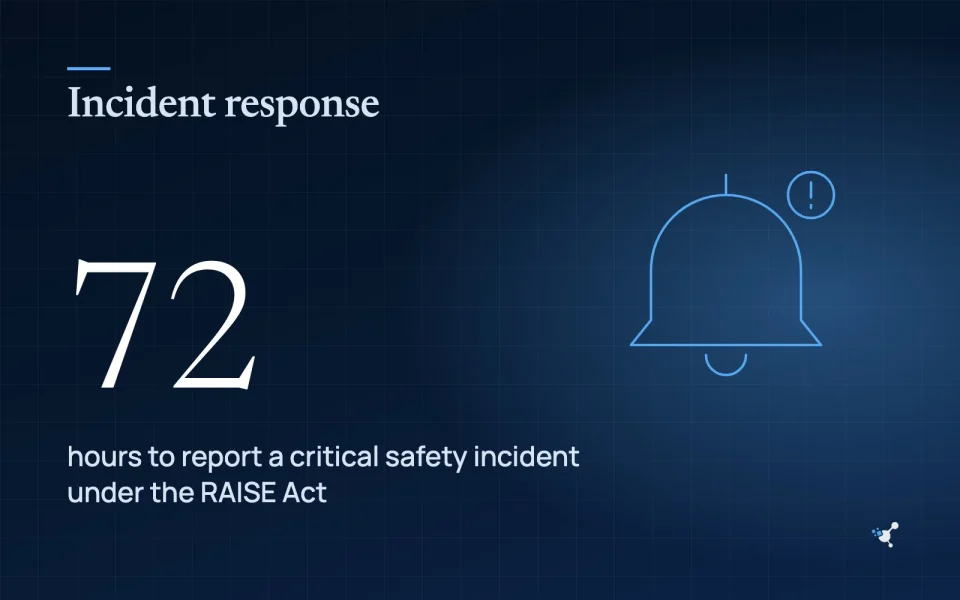
AI incident response: write the plan before the incident
Documented AI incidents rose by more than half in a year, and some are now reportable by law. A one-page procedure per system is the difference between a bad day and a crisis.
4 min read
Earn the AIMP certificationTwelve modules, a capstone plan and a timed exam. $695 to enroll ($595 for IAIM Members), with a verifiable certificate when you pass.
About the AIMP AI management certification