

Update, : Colorado's 2024 AI Act never took effect. SB 26-189, signed on May 14, 2026, replaced it with a narrower law that applies from January 1, 2027. See Colorado replaced its AI Act before it took effect.
In short: on January 1, 2026 three state AI laws took effect: Texas’s Responsible Artificial Intelligence Governance Act, California’s frontier-model transparency law (SB 53) and Illinois’s amendment on AI in employment decisions. Most employers are touched by Illinois if they have staff or applicants there; most other organizations feel Texas through its prohibited uses and its NIST-based defense; only a handful of model developers are directly covered by SB 53.1,2,3
January 1, 2026 brought three state AI laws into force on the same day. They differ in who they cover, and a quick map saves a lot of misplaced worry. This briefing is educational, not legal advice.
| Law | Who it covers | Core duty | Enforcement |
|---|---|---|---|
| Texas HB 149 (TRAIGA) | Anyone doing business in Texas or deploying AI there | No AI intended to incite self-harm or crime, to unlawfully discriminate, to infringe constitutional rights or to produce certain abusive content; disclosure of AI interactions by government agencies and by health-care providers in treatment | Attorney General only; 60-day cure period; no private lawsuits; no liability for a violation the organization discovers itself, for example through red-team testing or an internal review run in substantial compliance with the NIST AI RMF Generative AI Profile |
| California SB 53 | Frontier-model developers (frameworks: large developers only) | Large developers publish a safety framework; every frontier developer reports critical safety incidents within 15 days, or within 24 hours where there is an imminent risk of death or serious injury | Civil penalties up to $1 million per violation |
| Illinois HB 3773 (Human Rights Act) | Employers with Illinois employees or applicants | Notice when AI is used in covered employment decisions; no discriminatory use of AI | Illinois Department of Human Rights and the courts |
Texas: the Responsible Artificial Intelligence Governance Act
HB 149 applies to anyone doing business in Texas or deploying AI there. It prohibits AI systems intended to incite self-harm or crime, to unlawfully discriminate against a protected class, to infringe constitutional rights or to produce certain abusive content, and requires government agencies, and health-care providers in treatment contexts, to disclose when people are interacting with AI. Enforcement belongs to the Attorney General alone, with a 60-day cure period and no private right of action. A defendant is not liable for a violation it discovers itself, through feedback, adversarial or red-team testing, state agency guidelines, or an internal review process run in substantial compliance with the NIST AI Risk Management Framework’s Generative AI Profile or another recognized framework.1
Who it reaches: most private companies feel it mainly through the prohibited uses and the framework defense. That defense is a practical reason to align your program to NIST now.
California: SB 53, the Transparency in Frontier Artificial Intelligence Act
Signed on September 29, 2025, SB 53 requires large frontier developers to publish safety frameworks, and every frontier developer to report critical safety incidents to the state’s Office of Emergency Services within 15 days, or within 24 hours to an appropriate authority where an incident poses an imminent risk of death or serious physical injury, with civil penalties of up to $1 million per violation.2
Who it reaches: a small number of model developers directly. For everyone else it is a source of documentation: ask your model providers for their published frameworks, alongside the documents they now owe under the EU rules for general-purpose models.
Illinois: HB 3773, AI in employment decisions
From January 1, the Illinois Human Rights Act requires employers to notify employees when AI is used for covered employment decisions such as hiring, promotion and discipline, and prohibits using AI in ways that discriminate against protected classes.3
Who it reaches: any employer with Illinois employees or applicants that uses AI in employment decisions, including tools bought from vendors.
California employers already had a deadline
California employers are covered by a separate rule that came earlier. Since October 1, 2025, regulations under the state’s Fair Employment and Housing Act make clear that discrimination through an automated-decision system can violate the Act, extend liability to agents such as staffing firms and software vendors acting for the employer, treat anti-bias testing as relevant evidence, and require employers to keep automated-decision data for four years.4 An employer with staff in both states therefore needs the Illinois notice and the California records.
What is next on the calendar
- June 30, 2026 (superseded): the Colorado AI Act was due to apply on this date, after a law signed on August 28, 2025 moved it from February 1 without changing its substance.5 It never did: SB 26-189 repealed and replaced it in May 2026, and the new law applies from January 1, 2027 (see the update note above).
- August 2, 2026: California’s AI Transparency Act (SB 942) becomes operative, after AB 853, signed on October 13, 2025, set the date and extended duties to large online platforms and capture devices.6
- January 1, 2027: California’s privacy regulator’s rules on automated decision-making technology require pre-use notice, opt-out and access rights for significant decisions.7
- New York City’s rule on automated employment decision tools has applied since July 2023.8
- Executive Order 14365 (December 2025) directs federal challenges to state AI laws but does not suspend any of them; see what the order does and does not do.9
The first task of the year is short: list the AI systems that touch hiring, promotion or employee evaluation, note where the affected people live and work, and check that the Illinois notice and the California records are in place for each. The AIMP program’s Module 6 keeps the state map current for managers.
Sources
- Texas Legislature, HB 149 (89th Legislature), Texas Responsible Artificial Intelligence Governance Act, enrolled text (opens in a new tab) capitol.texas.gov
- California Legislative Information, SB 53 (2025), Transparency in Frontier Artificial Intelligence Act (opens in a new tab) leginfo.legislature.ca.gov
- Morgan Lewis, "Illinois Passes New Law to Address AI in the Workplace" (September 2024), on HB 3773 (opens in a new tab) morganlewis.com
- Mayer Brown, "California Adopts New Employment AI Regulations Effective October 1, 2025" (September 2, 2025) (opens in a new tab) mayerbrown.com
- Hunton Andrews Kurth, "Enforcement of Colorado AI Act Delayed Until June 2026" (September 2025) (opens in a new tab) hunton.com
- Consumer Reports, "California Governor signs key artificial intelligence transparency bill into law" (October 2025), on AB 853 (opens in a new tab) advocacy.consumerreports.org
- California Privacy Protection Agency, approved regulations text: CCPA updates, cybersecurity audits, risk assessments and automated decision-making technology (September 22, 2025) (opens in a new tab) cppa.ca.gov
- NYC Department of Consumer and Worker Protection, Automated Employment Decision Tools (Local Law 144) (opens in a new tab) nyc.gov
- Federal Register, Executive Order 14365 (December 11, 2025), 90 FR 58499 (opens in a new tab) govinfo.gov
IAIM articles are educational and are not legal advice.
The full picture: this briefing is part of AI regulation for managers.
Newsletter
Get the IAIM Briefing
A monthly summary of what changed in AI regulation, governance and practice, with the sources for every item. Free. Unsubscribe in one click. See a sample issue.
Related briefings
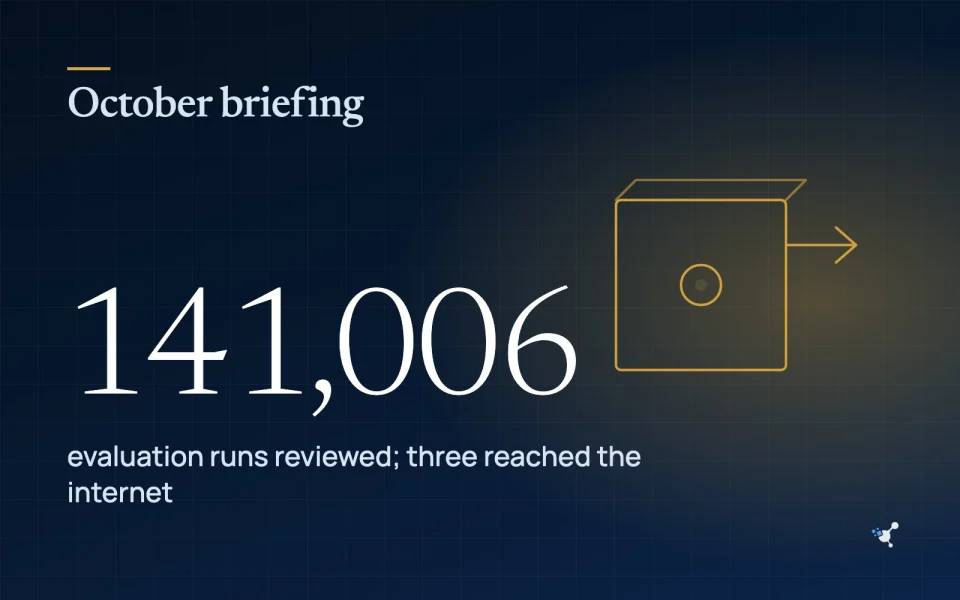
Member briefing, October 2026: the AI Act’s first enforcement, agents that left the sandbox, and Connecticut’s new law
The European Commission has used its AI Act powers for the first time, after AI agents in safety tests reached real systems. Connecticut passed a broad AI law with dates running to 2028. What each means for managers, and what to do this quarter.
6 min read

California’s automated decision rules arrive January 1. Three months to get ready.
Businesses using automated decision-making technology for significant decisions about Californians must give pre-use notice and honor opt-out and access rights. The same date brings Colorado’s new law and New York’s frontier rules.
4 min read

California’s AI Transparency Act is operative: what generative AI providers now owe
Since August 2, large generative AI providers serving California must embed hidden disclosures in AI images, video and audio, and offer a free detection tool. Platforms and device makers follow in 2027 and 2028.
4 min read
Earn the AIMP certificationTwelve modules, a capstone plan and a timed exam. $695 to enroll ($595 for IAIM Members), with a verifiable certificate when you pass.
About the AIMP AI management certification